
Our Data Use and Documentation Statement below provides a brief overview of data sources, definitions, and approaches used to produce our estimates for Immigrants without Permanent Residence (IWPR). It lists data limitations and terms of use.
For more details, read our in-depth Methodology Statement (PDF).
For further questions on our Methodology, leave us a comment on Researcher Q&A →
Migration Metrics Data Use and Documentation Statement
This data archive provides modeled estimates of the immigrant population without permanent residence (IWPR) in the United States, alongside estimates of their U.S.-born, co-resident children ages 0-17 (anticipated in 2026). For comparison, the data also provides estimates for three groups of immigrants with permanent residence: lawful permanent residents, nationalized citizens and nonimmigrants with temporary visas. The data currently span 2005–2023. The dataset was developed using refined residual methodology, offering population-level insights on size, characteristics, and demographics of foreign-born groups.
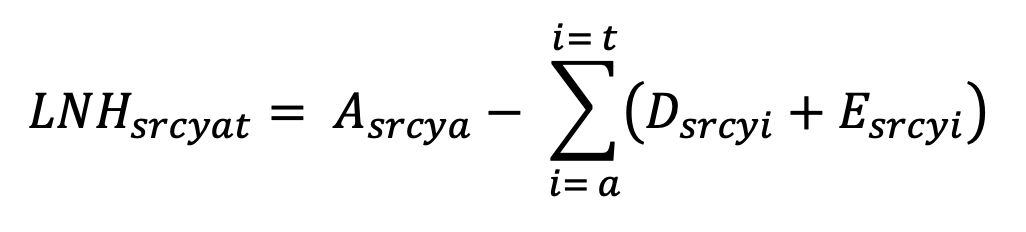
Estimates of the IWPR population are generated by subtracting the number of legally foreign-born individuals – derived from U.S. Department of Homeland Security (DHS) administrative records –- from the total foreign -born population reported in American Community Survey (ACS). Legal classifications include lawful permanent residents (LPR), naturalized citizens, nonimmigrants (students, temporary workers), and those with humanitarian protection. Arrivals before 1982 are also assumed to have legal status under the Immigration Reform and Control Act of 1986. IWPR subgroups include individuals who entered without inspection, overstayed temporary visas, or have uncertain or temporary protections (e.g. TPS, DACA, parole, pending asylum). Estimates of co-residential U.S.-born children are derived from matched IWPR parental profiles in the ACS and validated using fertility data from the Survey of Income and Program Participation (SIPP). Adjustments correct for undercounts and year-of-arrival misreporting in ACS data.
Estimates are disaggregated by age, sex, country or region of birth categories, year of entry, duration of U.S. residence, and age at arrival.
All estimates are accompanied by 95% confidence intervals derived from 100 bootstrapped samples. All estimates are subject to rounding, suppression rules, and disclaimers to ensure clarity and avoid misinterpretation.
For a deeper dive into the methods, read our Methodology Statement and take a look at our publications on the size, characteristics, and dynamics of the unauthorized foreign-born population.
- This article develops a new methodology for estimating the dynamics of the unauthorized foreign-born population — inflows, outflows, and the average length of time people remain in an unauthorized status. Van Hook, Jennifer. 2024. “Beyond Stocks and Surges: The Demographic Impact of the Unauthorized Immigrant Population in the United States.” Population and Development Review 50(4), 1369-1400.
- This article explores how certain we can be about our estimates of the unauthorized foreign-born population. Van Hook, Jennifer, Anne Morse, Randy Capps, and Julia Gelatt. 2021. “Uncertainty About the Size of the Unauthorized Foreign-Born Population in the United States.” Demography 58(6): 2315-2336.
- This article calls attention to the fact that the unauthorized foreign-born population is aging rapidly, particularly among immigrants from Mexico. Van Hook, Jennifer and Mara Getz Sheftel. 2025. “The Growth and Diversity of Older Undocumented Immigrants in the United States.” Demography (forthcoming).
Data Use and Interpretation Guidelines
- Modeled Data: These are modeled estimates not direct counts.
- Uncertainty and Rounding; All figures are rounded to the nearest 1,000. Estimates under 1,000 or with margins of error larger than the estimate are suppressed.
- Intended Uses: Data is intended for scholarly, policy, and public service use.
Data Limitations
- No individual-level data: All data are aggregated; no microdata or personally identifiable information is included.
- 2020 ACS Gap: Estimates for 2020 are interpolated due to known data quality issues related to challenges of data collection during the COVID-19 pandemic.
- Coverage Adjustment: IWPR estimates are adjusted for the underrepresentation of unauthorized immigrants in U.S. Census data using demographic benchmarks and smoothing methods.
Terms of Use
By downloading or accessing this dataset, you agree to the following:
- Redistribution: You will not redistribute the data. All data extracted from the U.S. Migration Metrics database are intended solely for the use of the data user. Redistribution of the data to third parties is prohibited.
- Usage: You agree to use U.S. Migration Metrics data for scholarly, policy research or educational purposes only. Uses involving surveillance, enforcement, or commercial activities are prohibited.
- Confidentiality: You will not use the data to identify individuals. All U.S. Migration Metrics data are aggregated; no microdata or personally identifiable information is included. Any attempt to ascertain the identity of persons or households from the data is prohibited. Alleging that a person or household has been identified in these data is also prohibited.
- Cite U.S. Migration Metrics data appropriately: If using the data, please cite:
Van Hook, J., Kreisberg, N., Persaud, H., Bodovski, Y., & Gelatt, J. (2025). U.S. Migration Metrics. (Link)
Publications and research reports making use of U.S. Migration Metrics data should be added to our bibliography.
Contact
For questions, documentation, or scenario suggestions, email:
Stay informed via our Instagram [@u.s.migrationmetrics], Twitter/X [@USMigMetrics], BlueSky [@USMigrationMetrics], or LinkedIn [@U.S. Migration Metrics].